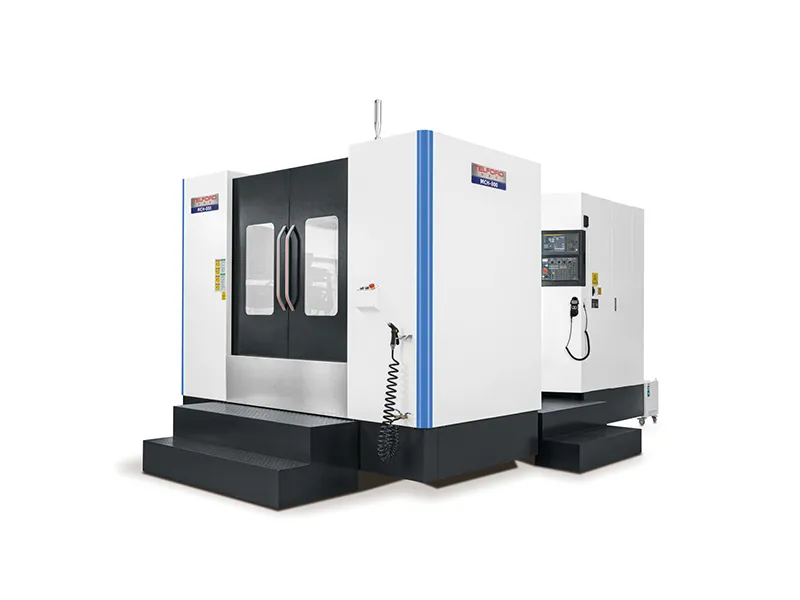
Box-shaped components such as gearbox housings, valve bodies, hydraulic manifolds, pump housings, engine components, and structural cases often require machining on several sides.
Producing these parts efficiently can be difficult on a machine where operators repeatedly remove, rotate, and re-clamp the workpiece.
A horizontal machining center addresses this challenge by positioning the spindle horizontally and allowing the machine to access different faces of the component more efficiently. Combined with rotary tables, pallet systems, automatic tool changers, and rigid machine structures, the configuration can support high-productivity machining of complex parts.
The advantage is not simply that the spindle points sideways. It is how the entire machine architecture changes workpiece access, chip removal, setup strategy, and batch production.
Why Box-Type Parts Are Difficult to Machine Efficiently
A box-type component may contain features on several surfaces:
bearing bores;
mounting holes;
threaded holes;
pockets;
sealing faces;
internal cavities.
On a basic vertical machine, operators may need to machine one side, stop the process, reposition the workpiece, re-establish datums, and continue on another face.
Every additional setup introduces:
labor;
setup time;
fixture complexity;
potential datum error;
work-in-process delay.
A horizontal cnc machine can reduce this problem when paired with a rotary worktable.
The component can remain clamped while the table rotates to expose another side to the spindle.
This does not eliminate all setup challenges, but it can significantly reduce repeated manual re-clamping.
For parts requiring multiple machined faces, this becomes a major productivity advantage.
Horizontal Spindle Orientation and Gravity-Assisted Chip Removal
Chip evacuation is one of the most practical advantages of horizontal machining.
During milling on a vertical machine, chips can collect inside deep pockets and cavities.
If chips remain in the cutting zone, they may be recut by the tool, increasing heat and potentially reducing tool life or surface quality.
A horizontal machining center benefits from gravity because chips naturally fall away from many cutting surfaces.
This is especially useful when machining:
deep pockets;
gearbox housings;
internal cavities;
heavy castings.
Coolant and chip conveyors can then move debris away from the machining zone.
Better chip evacuation can support more stable automated operation because operators do not need to stop the process as frequently to clear accumulated material.
For unattended or extended production, this practical detail can be as important as rapid traverse speed.
Multi-Face Machining: Reducing Re-Clamping for Box Components
Multi-face machining is a major reason manufacturers choose a horizontal cnc milling machine.
With a rotary table or pallet, the machine can access multiple sides of the workpiece within one setup.
For example, a housing might require:
front face → right face → rear face → left face.
Rather than manually repositioning the part four times, the table can index the component automatically.
Reducing setups provides two benefits.
First, cycle efficiency improves.
Second, dimensional relationships between features on different faces can be easier to control because the component remains located from the same primary setup.
This can be valuable for:
Less handling also reduces the risk of workpiece damage during intermediate transfers.
For complex box parts, manufacturers should therefore compare the number of setups required—not simply the nominal spindle power of competing machines.
Why Rigidity Matters During Heavy Milling and Boring
Many box-type parts are made from cast iron, steel, or other materials that require substantial cutting forces.
Large bores, deep milling passes, and heavy face machining place significant load on the machine structure.
A horizontal machining center intended for this work needs rigidity across:
machine bed;
column;
spindle;
rotary table;
guideway system;
fixture.
Insufficient rigidity can contribute to chatter, reduced tool life, poor surface finish, and difficulty maintaining tolerance.
Spindle torque also matters.
High spindle speed is useful for small tools, but large cutters and boring operations may require strong low-speed torque.
When evaluating a horizontal machine, buyers should therefore provide representative part drawings and material information.
The correct machine cannot be selected from workpiece dimensions alone.
Material removal rate, bore size, cutting-tool diameter, fixture weight, and target cycle time all influence the required configuration.
Pallet Systems and Their Role in Batch Production
Palletization can significantly improve machine utilization.
On a conventional machine, the spindle may remain idle while an operator unloads the finished part and installs the next workpiece.
A pallet-changing horizontal machining center can separate loading from machining.
While one pallet is inside the machine, an operator or automation system can prepare another outside the machining zone.
When the cycle finishes:
finished pallet exits → prepared pallet enters → machining resumes.
This reduces spindle idle time.
Pallet systems are especially valuable for:
Multiple pallets can also support different part numbers, allowing a factory to schedule production more flexibly.
However, pallets and fixtures require investment and floor space.
The economic value therefore depends on production quantity and expected machine utilization.
Which Parts Benefit Most from a Horizontal Machining Center?
A horizontal machining center is particularly attractive for components requiring several machined faces or efficient chip removal.
Typical examples include:
A simple flat plate requiring operations only on the top surface may not justify a horizontal configuration.
A vertical machining center could complete such work more economically.
The strongest HMC applications normally combine several factors:
multiple faces + complex cavities + batch production + significant chip volume
Manufacturers should also consider future products.
If a factory expects to move from simple components toward more complex multi-face housings, investing in a horizontal platform may provide useful long-term capacity.
Horizontal Machining Center FAQs
What is the main advantage of a horizontal machining center?
A horizontal machining center can efficiently access multiple sides of box-type components while supporting strong chip evacuation and automated pallet handling.
Is a horizontal machine more accurate than a vertical machine?
Machine accuracy depends on the specific design and process. The main advantage for multi-face parts is reduced re-clamping, which can help maintain feature relationships between different surfaces.
Why is chip evacuation better on an HMC?
The horizontal spindle orientation allows gravity to help chips fall away from many pockets and cutting surfaces.
What parts are commonly machined on horizontal CNC machines?
Gearbox housings, valve bodies, hydraulic blocks, pump housings, engine parts, and other box-type components are common applications.
Is a pallet changer necessary?
No, but it can significantly reduce spindle idle time in batch production.
Should every factory choose an HMC over a VMC?
No. A horizontal cnc machine offers the greatest advantage when the workpiece requires multiple faces, strong chip removal, and high machine utilization.
For complex box components, the real value of a horizontal machining center comes from combining multi-face access, rigidity, chip control, and automated workpiece handling into one production platform.